
People

Stepping Up to the Plate
How a .038 hitter for the Jumbos ended up a home-run writer at Fenway Park
June People Notes
In This Corner
The Fuse That Lit The Fire
Jackie Robinson broke baseball’s color barrier, but his struggle isn’t over yet
Stepping Up to the Plate
How a .038 hitter for the Jumbos ended up a home-run writer at Fenway Park
By Bill Finley, A83
Tony Massarotti, A89, grew up in the Boston suburb of Waltham, worshipping the Red Sox. His dream was to be the next Fred Lynn, he says, referring to the beloved Sox slugger of the seventies. Then came his second season on the junior varsity team at Tufts: he had exactly one hit in 26 at-bats. But he still didn’t give up on the idea of a future at Fenway Park. He just traded his bat and glove for a pen and a reporter’s notebook.
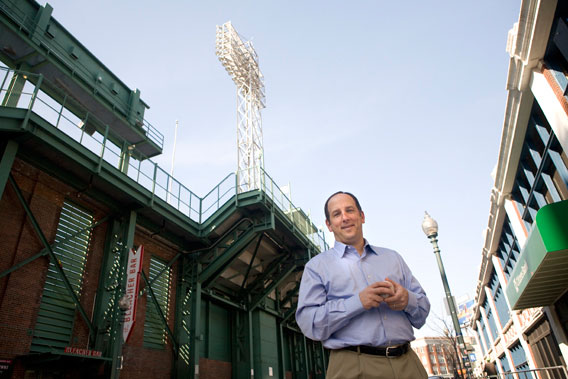
“You have to win your credibility,” says Tony Massarotti, A89, sportswriter for the Boston Globe. “It’s not given to you.” Photo: John Soares
He started with the sports section of the Tufts Daily, where he soon discovered that the new career path he had chosen wasn’t going to be easy, either. “I was an atrocious writer,” he admits.
But the kid who couldn’t hit or write has done pretty well for himself. After a long career at the Boston Herald, he was tapped by the rival Boston Globe last year to become the main face of the paper’s sports website. Along the way, he has grown into one of the most prominent voices on the New England sports scene—a frequent presence on TV and radio and a two-time winner of the Massachusetts Sportswriter of the Year award.
His journey to professional success began 20 years ago, when, as graduation neared, he connected with a fellow Jumbo, Tim Horgan, A49, then a columnist at the Boston Herald. Horgan helped get him a job answering phones in the Herald’s sports department. There, Massarotti decided that even if he wasn’t a born wordsmith, he could improve if he put his mind to it.
“You learn how to write by reading people who know how to write,” he explains. “Then it’s just a matter of applying that and working at it. If you’re a sports fan who grew up in Boston, you got to grow up reading Peter Gammons, Bob Ryan, Dan Shaughnessy, Will McDonough. These guys are among the most accomplished writers and reporters in the history of the industry. You can learn a lot by seeing how they do their job.”
Massarotti did learn, and quickly moved up the Herald pecking order. He was promoted to staff reporter in 1992. Three years later, he got the break of a lifetime. “My sports editor called me and said, ‘Hey, how would you like to cover the Red Sox?’ ” he recalls. “I was ecstatic. I remember pinching myself, thinking, ‘Is this for real?’ ” Over the next 14 seasons, he emerged as the paper’s key Red Sox writer. His greatest asset was his reporting skills—plus a knack for breaking major stories.
“There were a couple of stories that really helped springboard me to bigger things,” he says. One was pitcher Roger Clemens’s departure from the Red Sox in 1996 after a bitter contract dispute. “We had that before anyone else did.” And in 1997, when the Red Sox acquired Pedro Martinez, another star pitcher, Massarotti got the scoop once again. “You have to win your credibility,” he says. “It’s not given to you.”
When the 2004 season rolled around, Massarotti had covered nearly 2,000 games and had turned his hand to just about every baseball story conceivable. All that was missing was one about a Red Sox World Series win, the glory that had eluded the team since 1918. And then it happened. The Sox, having lost three straight games to their archrivals, the Yankees, in the 2004 American League Championship Series, proceeded, improbably, to win the next four. They moved on to the World Series, where they ended 86 years of misery by sweeping the St. Louis Cardinals.
“I remember at the end of Game Seven in Yankee Stadium and at the end of Game Four in St. Louis, I told myself to take a minute, stand there, and watch the celebration,” Massarotti says. “It was, quite literally, an historic occasion.”
By 2008, he was fretting less about the team’s prospects than about the state of the news business. Like newspaper staffers everywhere, he worried that his employer might not survive. He also had a wife and two young children. So when he was courted by the Boston Globe, which seemed at the time to be on sturdier ground, he couldn’t say no. He made the move in September.
Not much has changed, despite the switch to mostly web-based reporting. Massarotti is still entrusted with keeping those rabid Red Sox fans informed about their team. The only difference is that, working for what aims to be a 24-hour sports destination—“the place where you are constantly tuning in to find out what’s going on,” as he puts it—Massarotti can never take a breather. Stories break at all hours, and he must post them online as soon as humanly possible.
His job might be a bit more difficult, but you will never hear him complain. This is a man who gets paid to hang out at the ballpark and watch baseball games. The .038 hitter made the major leagues after all.
This article first appeared in the Spring 2009 issue of Tufts Magazine.
The author writes for ESPN.com and the New York Times and cohosts a horse-racing program on Sirius XM Satellite radio.